September 27th, 2026 – https://www.citizenjazz.com/
by Franpi Barriaux
Après les racines carrées, voici l’astronomie : la pianiste nippone Rieko Okuda a donc décidé de faire souffrir les plus littéraires d’entre nous… Heureusement, les Points de Lagrange qui donnent leur nom à l’album n’ont d’autre fonction que celle de titre. Si l’on fait exception de l’atmosphère chaotique et cosmique qui nimbe cette rencontre d’Okuda avec le saxophoniste Peter van Huffel et la percussionniste Sofia Borges, sensible dans l’entropie électronique de « Ghost Currents », c’est bien de musique improvisée qu’il s’agit, exubérante en diable. On retrouve en trame de fond la robustesse de la main gauche de la pianiste, opiniâtre et intense, qui construit avec le saxophone baryton du Canadien Peter van Huffel une alliance des profondeurs, fuligineuse et dévastatrice.
Le jeu d’Okuda est assez fascinant, car il joue sur tous les plans avec un luxe de détails. D’un chambardement digne du big-bang, elle peut passer à la douceur presque irréelle d’un piano préparé sur « Parallax », qui tinte avec une certaine bonhomie, laissant le saxophone dominer un flux où l’électronique prend une place prépondérante. Le travail sur le son est fiévreux et très nerveux. Il donne à la musique du trio une sensation de mouvement permanent qui tutoie l’urgence et lance d’autres mécanismes parallèles, qu’ils soient l’apanage du piano ou de la batterie insatiable de Sofia Borges. Cette dernière est vraiment au centre du projet, dans les débordements rythmiques de « Ghost Currents » comme dans les effets sonores troubles de « Parallax ». La batteuse portugaise est une habituée des atmosphères tourmentées, comme on avait pu l’entendre sur Pink Monads dont l’énergie se rapproche de ce disque, paru lui aussi chez 4ad Records.
La relation entre Borges et Okuda est elle aussi très importante. Elle se cache dans de plus menus détails, mais fait état d’un équilibre des forces qui donne à Lagrangian Points sa solidité. Ce n’est pas la première fois que les deux musiciennes se rencontrent, on avait pu les entendre dans le quintet SORBD où l’engrenage de la batterie et du piano était déjà très robuste. On l’entend ici avec « Hypnopompia » : la dynamique du trio est forte dans un contexte rendu parfois abstrait par l’électronique, qui ajoute une dose de mystère et d’inconnu tout à fait pertinente.
For full original review click here or above
July 11th, 2026 – https://www.freejazzblog.org
by Stuart Broomer
Equally mixed in its combinations of the acoustic and the electronic, Lagrangian Points differs significantly in being a documentary recording of a live performance from Berlin’s Morphine Raum, all the electronic processing going on simultaneously with the acoustic. Sofia Borges plays drums. percussion and electronics; Rieko Okuda, piano, keyboards and electronics; Peter Van Huffel alto and baritone saxophones and electronics.
According to the liner note “ Lagrangian Points are zones of delicate balance where forces align and bodies can remain suspended. In that sense, the trio forms a system of its own: each voice holds and is held by the others, maintaining a moving equilibrium, with enough space left open for the imagination to drift beyond its edges.” That particularly double identity is linked to the presence of electronics employed by each trio member, to the extent that instrumental identities can blur into one another.
The opening “Ghost Currents” initially seems to emphasize Okuda’s electronic keyboards and Borges’ percussion, but within moments the music’s distinctive complexity is apparent, many of the sounds traceable to their acoustic origins, but nonetheless operating in a transformative state, the three elaborating waves of sound that might suggest a wholly electronic extension of an improvising ensemble akin to Cecil Taylor’s trio with Andrew Cyrille and Jimmy Lyons.
“Parallax” introduces a subtle world of discreet electronic distortions, near-invocations of piano strings and metallic percussion all of these combining to suggest alien transmissions from space as well as a distinctly human music. Just as Alexander Hawkins’ electronic webs on No Nation But Imagination can make Nicole Mitchell’s flute seem alien, Van Huffel’s alto here might be purely acoustic at times, yet his aptitude for abstraction is such that his alto suggests something quite different, almost a harmonica, its voice swimming in an electronic maze, until electronic alterations to the saxophone draw it wholly into an intermediate zone floating between the acoustic and the electronic.
With the final track, “Hypnopompia”, Van Huffel’s saxophone initially provides an acoustic line in an alien soundscape, but as the surrounding sound grows increasingly menacing (there is a suggestion of hybrid alien predators), his sound gradually mutates, becoming closer and closer to the world that surrounds him, achieved with a brilliant combination of acoustic and electronic techniques. As Van Huffel moves further towards the electronic, Borges briefly inhabits the acoustic role, but the ultimate group movement will be almost wholly electronic.
For full original review click here or above
June 7th, 2026 – orynx-improvandsounds.blogspot.com/
by Jean-Michel Van Schouwburg
Mention sur le site bandcamp de Sofia Borgès : This album is dedicated to those who had no voice in war but bore its deepest wounds. Cet album est dédié à ceux qui n’ont pas eu voix au chapitre pendant la guerre mais qui en ont porté les blessures les plus profondes. J’aurais ajouté une autre ligne au sujet des personnes trompées par la propagande qui soutiennent les guerres de leurs gouvernements en croyant être à l’abri des conséquences alors qu’ils seront un jour rattrapés par celles-ci.
Inclues dans les commentaires de ces trois artistes : Les points de Lagrange sont des zones d’équilibre fragile où les forces s’alignent et où les corps peuvent rester en suspension. En ce sens, le trio forme un système à part entière : chaque voix soutient les autres et est soutenue par elles, maintenant un équilibre mouvant, laissant suffisamment d’espace pour que l’imagination puisse vagabonder au-delà de ses limites.
Cet album contient une musique improvisée collective où interviennent des instruments électroniques joués par chacun des musiciens, principalement Rieko Okuda et Sofia Borges dans une dimension instrumentale et orchestrale à part entière avec en contrepoint le souffle aux larges intervalles harmoniques de Peter Van Huffel. On apprécie aussi ses interventions au sax baryton interférant avec les zig zags de ses deux collègues. Du point de vue créatif , j’apprécie beaucoup le travail en musique électronique à la fois adjacent primordial et complémentaire de ces trois artistes tout en leur concédant la lberté totale que devrait accepter un auditeur exigent ou même occasionel : ile ne faut pas essayer de distinguer qui fait quoi dans ce trio , sauf bien sûr qu’il n’y a qu’un seul saxophoniste et qu’on devine l’action de la pianiste à certains moments .. pas très pianistiques … mais plutôt sonores. Leur contribution au niveau électronique est à la fois consistante, créative, d’une conception orchestrale réussie et même innovante. Il y a du contenu, de l’énergie , de l’imagination et des échanges réussis. Un excellent trio qui ne ressemble qu’â lui-même. Encore un bon point pour 4DARecords et son patron João Madeira. C’est aussi je crois la troisième contribution de Sofia Borgès pour ce label où elle amène à chaque fois des idées nouvelles.
For full original review click here or above
June 4th, 2026 – Salt Peanuts
by Allan Sommer
En international trio med base i, (surprise!) Berlin. Trioen består af den portugiske slagtøjsspiller og trommeslager Sofia Borges, den japanske pianist Rieko Okuda og den canadiske alt- og baritonsaxofonist Peter Van Huffel. Alle tre bidrager med electronics. Tre musikere dedikeret til udforskningen af deres respektive instrmenter og hvilke klangmuligheder der ligger i de enkelte toner.
Sofia Borges er en musiker der i øjeblikket trækker megen opmærksomhed. Hendes versatile spil har ladet sig høre i samarbejder med folk som Mia Dyberg, Signe Emmeluth, Alex Dörner, Craig Taborn, Mat Maneri, Brandon Lopez, Carlos ’Zingaro’, Joao Madeira, Helene Espvall og instruktøren og komponisten Heiner Goebels. Og helt aktuel er hun med duoen Unseen Pact med den argentinske saxofonist Ada Rave. Projekter som giver et meget godt indtryk af hendes spændvidde.
Rieko Okudas meritter tæller folk som Marshall Allen fra Sun Ra Arkestra, Calvin Weston, kendt fra Ornette Colemans senere bands, og i Berlin arbejder hun med Alex Dörner og Tobias Delius. Desuden indgår hun i sammenhænge med danseteater. Har efter studier i elektronisk musik i Sverige blandt andet optrådt som sådan i Koncertkirken i København.
Det nærmeste man kommer en veteran i trioen er den 47-årige Peter Van Huffel. Har over there spillet med folk som Chris Potter og Donny McCaslin. Flyttede i 2008 til Berlin hvor han bl.a. har indspillet med sin daværende hustru Sophie Tassignon og Samuel Blaser. Foruden har han med kvartetter og kvintetter en række udgivelser på det markante portugiske pladeselskab, Clean Feed. Her i blandt med sin fremragende punk jazz trio Gorilla Mask, med bassisten Roland Fidezius og trommeslageren Rudi Fischerlehner.
Til sammen har trioen en bred portefølje, men fællesmængden er nysgerrigheden efter det soniske. Det er reduktionistisk jazz/improvisationsmusik hvor alt som ikke fremmer udtrykket er skåret væk. Hensigten er at sætte de mindste og fineste nuancer i lyd i fokus. Musikken har sit udgangspunkt i den berlinske scene, men florerer også i Tokyo, London og Wien. Nogle af de karakteristiske træk ved musikken er brug af mikrotonalitet, klangudforskning af hvordan instrumentet interaliserer med åndedræt, kliklyde og støj. Ofte er musikken udført med ekstrem lav dynamik, stilhed og pauser. En af de fremtrædende repræsentanter for denne bevægelse i improvisationsmusikken er den tyske trompetist mm. Alex Dörner. Selvom pladen, som består af tre kompositioner, starter tyst med klare minimalistiske træk udvikler den sig hurtig til en kakofoni hvor de akustiske instrumenter intervenerer med de elektroniske lydgivere. Hele tiden i en balance hvor de enkelte lyde står klart og på den anden side hvor den samlet mængde af lyde internaliserer organisk. Det er en særdeles spændende, og krævende, musik Borges/Okuda/Van Huffel tryller frem.
For full original review click here or above
May, 2026 – by Maciej Lewenstein
***** Sofia Borges / Rieko Okuda / Peter Van Huffel:
Lagrangian Points 4DaRECORD 4DRCD022
CD Sofia Borges (perc, dr, elec); Rieko Okuda (p, keyb, elec);
Peter van Huffel (as, bs, elec). Recorded December 2024.
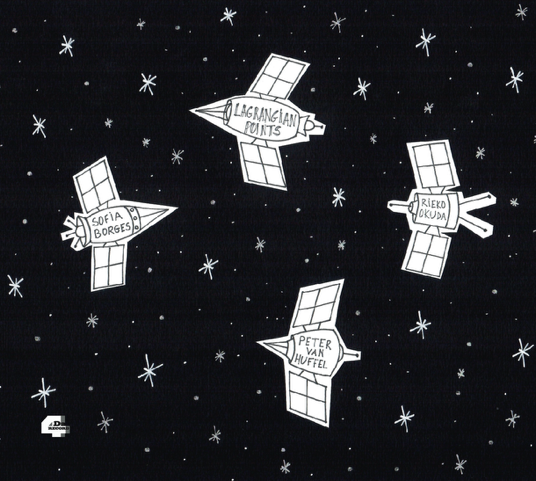
The phenomenal Sofia Borges is back on 4DaRECORD with an equally phenomenal trio, including Rieko Okuda and Peter van Huffel. The material was recorded live by Rabih Beaini at Morphine Raum in Berlin. Mixing and mastering were done by João Madeira, and the beautiful artwork was done by Sofia Borges herself. Quoting Bandcamp: “Borges, Okuda, and Van Huffel have long shared other constellations, but this is the first time the three lock into orbit as a trio. Peter van Huel (saxophone, electronics), Rieko Okuda (piano, electronics), and Sofia Borges (drums, electronics) moves through the full range of their electro-acoustic setups with ease, shifting between acoustic impulse and electronic extension. What begins as moving air is constantly reshaped into multidimensional narratives through density and texture until it feels closer to matter than sound.” Explaining the physical origins of the title: “Lagrangian points are zones of delicate balance where forces align, and bodies can remain suspended.”
The music is fully free improvised, and very lyrical and moody. There is, obviously, plenty of electronics and plenty of alternative sounds. The trilogy consists of three medium-long tracks, which start with the over 14-minute-long “Ghost Currents”, which is a masterpiece of building up the atmosphere and moods. “Parallax” is similar, yet more abstract, despite of more clearly exposed alto saxophone lines. Finally, “Hypnopompia”, finis coronat opus, the most free improvised jazz oriented track, and my favorite.
Please check back soon for more reviews …

